Masking potentially unblinding data — planned, executed, and provable.
Blinded studies still have to move data: programmers build pipelines, data managers review listings, vendors get extracts. Verdatic masks by declaration — you write down what unblinds and how, and that plan is applied to the datasets, the exports, and the programs themselves, with a record at the end that shows what was done and who accepted what.
The problem
A blinded study still has to move data around. Statistical programmers need to build and test pipelines, data managers need to review listings, vendors need extracts — and none of them should be able to work out who is on active treatment. The variables that would give it away are the potentially unblinding ones, and handling them is usually somebody’s script, written under time pressure, and not quite the same script next time.
- The obvious columns get masked and the signal survives anyway. Treatment variables are blanked, but the standard-units twin of a masked result still carries the value, or a reference-range flag does, or a supplemental qualifier, or a free-text comment, or a derivation that reaches around the mask entirely.
- Masking everything destroys the reason for masking. A blinded copy full of nulls can’t exercise the analysis code, so the dry run that justified the exercise gets deferred to real data after all.
- The programs are a second copy of the problem. Even a properly masked dataset is no use if the transformation programs handed to a partner reconstruct the signal from source.
- Nobody can show afterwards what was done. Which variables were masked, by which method, what residual risk was accepted and by whom — reconstructed later from memory and file dates.
Verdatic takes the opposite approach: masking by declaration. You write down which variables carry unblinding signal and how each should be handled, and that one declaration is applied everywhere the data goes — the generated datasets, the exports, the transformation programs, and a standalone program you can run on a raw vendor extract with Verdatic nowhere in the loop.
Risk and cost profile
We don’t publish savings percentages, and there is no benchmark study behind this page. One of these rows genuinely resists pricing — and we’d rather say so than invent a figure.
The consequence of a leak isn’t a line item. ICH E9 treats the blind as a design feature to be maintained, with any unblinding documented and explained; in practice a suspected leak means an investigation, a documented deviation, potentially removing people from analysis roles, and a conversation about the integrity of the analysis at the worst possible moment in a study. Nobody can put a defensible average on that, so we won’t.
| Cost driver | How it shows up | Price it with your own numbers |
|---|---|---|
| A leak | The masked copy still carries the signal — in a companion variable, a flag, a comment, a derivation. | Not priceable. Investigation, documented deviation, and a question mark over the analysis |
| Over-masking | Nulls everywhere; the blinded copy can’t exercise the analysis it was made for. | weeks of analysis programming displaced to after unblinding |
| One-off masking scripts | Written per request by whoever is free; reviewed each time; never quite identical. | hours per extract × extracts per study, plus the review of each |
| Proving it afterwards | Reconstructing what was masked, why, and who accepted what. | hours to assemble the evidence, per audit or per handover |
| Outbound extracts | Every vendor, partner and reviewer file needs the same treatment, consistently. | extracts per month × hours per extract, including the checking |
What we won’t claim: that this is a regulatory blind-maintenance system, or that masked output is submission material. It is synthetic development data, the blinding decisions remain yours to own and approve, and Verdatic’s job is to make them explicit, apply them everywhere, and print the record.
The workflow, at a glance
Two things make this different from masking after the fact. Verdatic usually created the signal, so it knows where the signal is — if you built a treatment effect into systolic blood pressure, it can tell you that variable is unblinding rather than leaving you to guess. And it can rebuild the study without the effect: one method re-runs the generator with the treatment difference forced to zero under the same seed lineage, producing a coherent blinded twin rather than scrambled data.
The Verdatic workflow
Masking is off until you say the study needs it. Once it’s on, a masked badge follows the project everywhere — on every tab and on its card in the project list — so nobody forgets which study they’re in.
Start from what Verdatic already knows unblinds
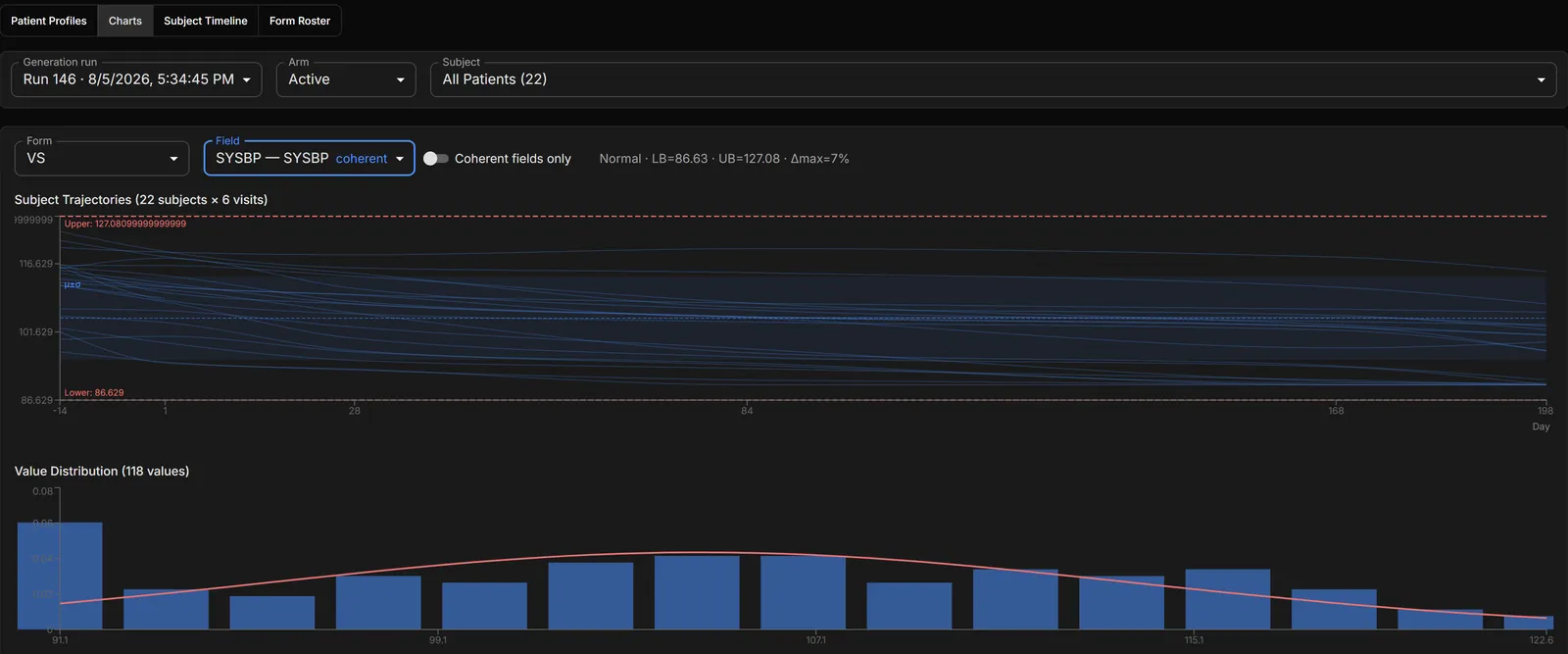
Candidates come from two independent places. Structural ones are unblinding by nature in any study — the treatment-arm variables, exposure and drug-accountability domains, arm-varying trial design — and are proposed only for surfaces your study actually has. Overlay candidates come from your own design: any field whose per-arm settings differ from the base is flagged, and the provenance line shows the exact per-arm difference that made it unblinding. They are suggestions, not rules; nothing is persisted until you accept, and dismissing one is recorded with a reason so it doesn’t resurface for the next person.
Write the rule: a scope and a method
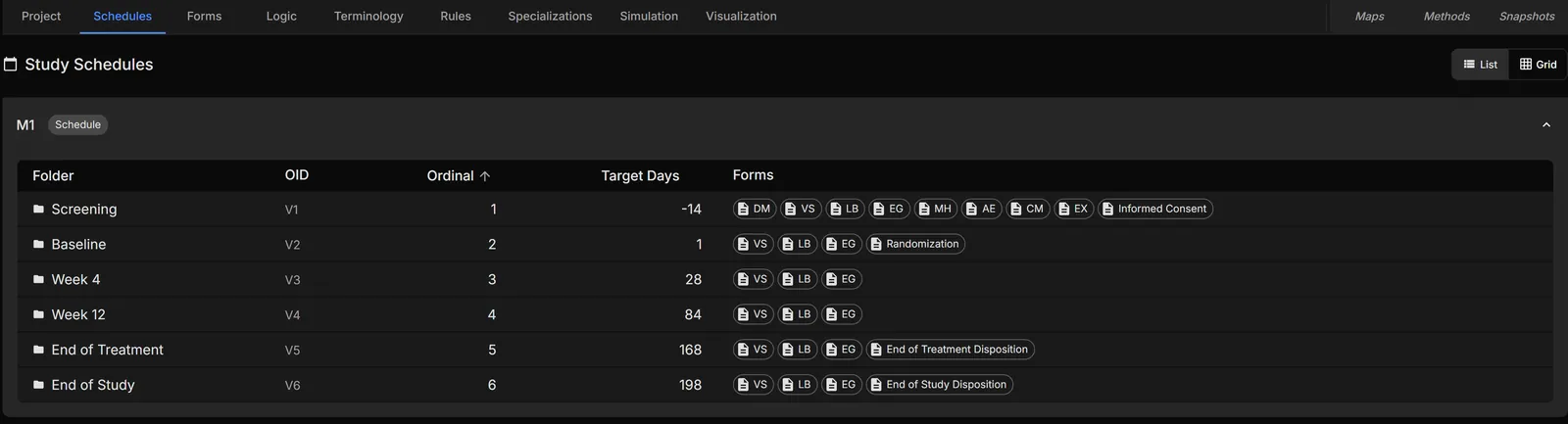
Scope narrows in four steps — domain, then variable (or the whole domain), then test code where it applies, then visits. Every picker is filled from your own study’s metadata, so you can’t scope a rule onto something that isn’t there. Where two rules overlap, the more specific one wins, which lets you set a broad default and carve out exceptions.
Pick the method that keeps what you still need
Nine methods, because “mask it” means nine different things depending on what has to survive. Blank the value outright. Redraw it from the study’s realism library so it still looks clinically sensible. Redraw from the pooled distribution of what’s actually there. Permute which subject each value belongs to, so aggregates tie out exactly. Quantile-map the arms onto each other so within-subject ordering survives. Recode categoricals to neutral, standards-valid terms so listings and conformance don’t break. Jitter dates by a per-subject offset that is consistent across every dataset. Coarsen a value — round it, threshold it, bin it — when a blinded reader legitimately needs some of it.
And the one no post-hoc tool can do: regenerate the scoped values with the treatment effect forced to zero, under the same seed lineage, so everything not driven by treatment stays identical and only the arm signal disappears. That produces a study a statistician can actually work with — not scrambled data, but a coherent study without a treatment difference. It needs the generative model, so it is the one method that doesn’t work on imported real data, and generated programs refuse it rather than substituting something weaker.
When a method can’t be applied — a stratum too thin, a scope that resolves to nothing — Verdatic falls back to blanking the value and counts it as a downgrade in the report. It never quietly leaves data unmasked.
Run the leak analysis, and be told what you missed
Masking one variable rarely finishes the job. The leak analysis looks for the signal everywhere else it could have survived, in six tiers: companion variables (the standard-units twin, the reference-range flag, the supplemental qualifier), mechanism correlates that move with what you masked, structural exposure of arm identity or arm-varying design, free-text fields, mapped targets that no rule covers, and the source graph — edit checks, derivations and panel siblings that reach around the mask.
High-severity findings block masked output. You cannot export a masked dataset, download a masked program bundle or emit a standalone program while one stands unwaived, and there is no override. You fix it with a rule, or you waive it with a written rationale that is recorded, audited, revocable and printed in the report.
Produce the masked artifacts — including the programs
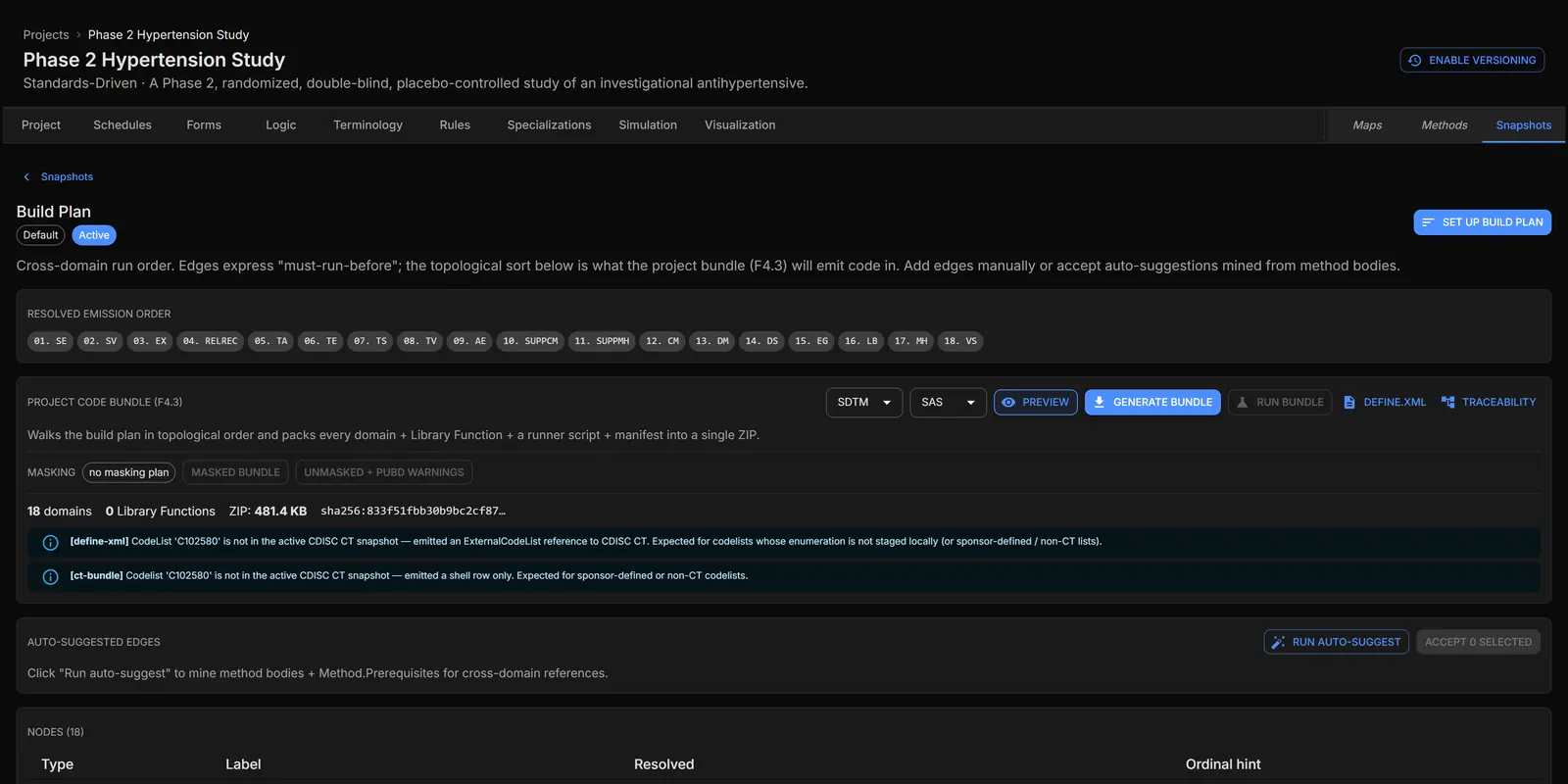
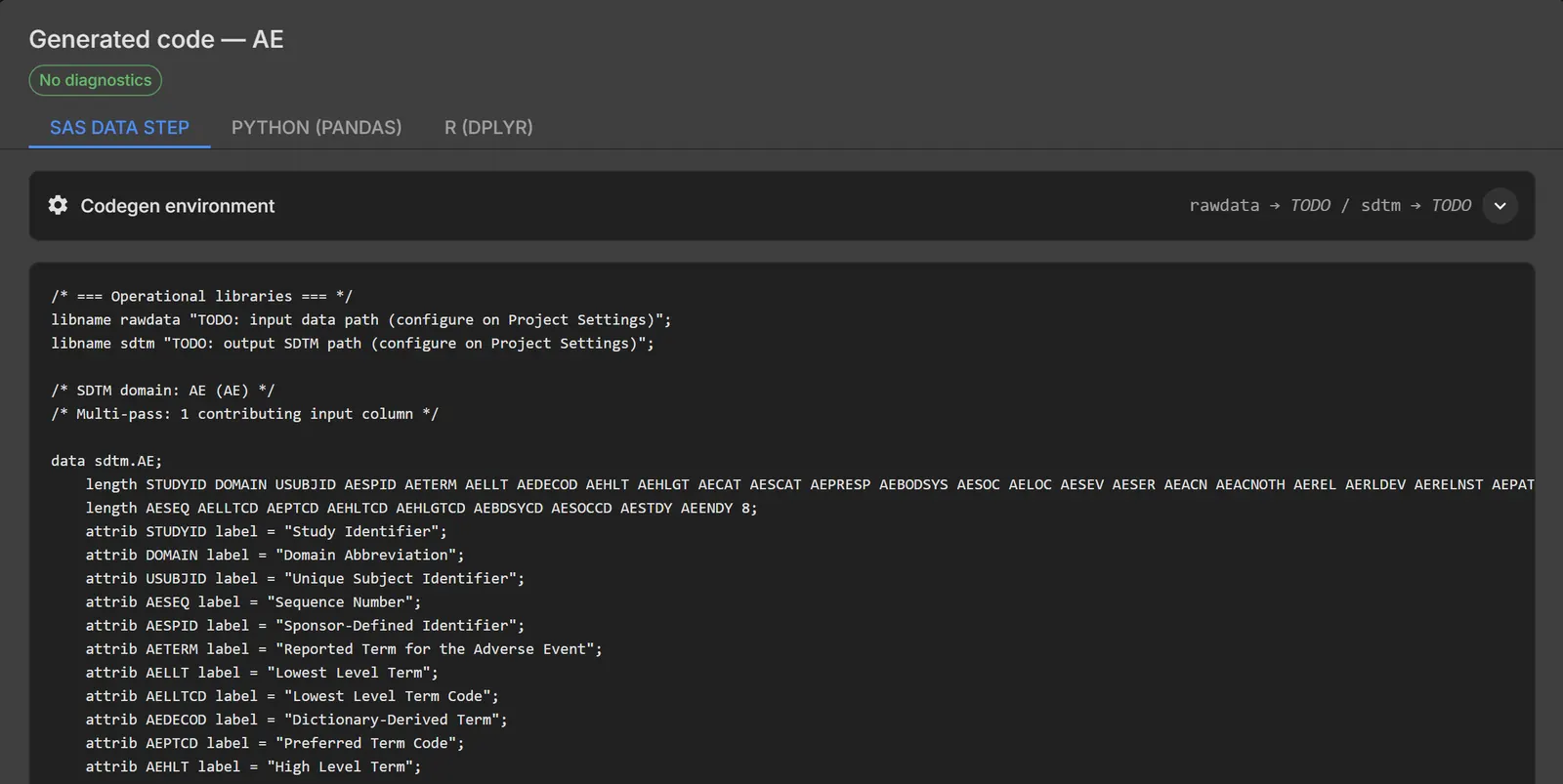
A masked generation run records its plan hash, seed, masked-cell count and downgrade count. A paired export ships both variants in one package, with the unmasked side explicitly labeled. A masked program bundle contains your SAS, R and Python with the masking applied in the programs, alongside the plan and the report — and the ordinary bundle is watermarked as unmasked so the two can never be confused. A standalone program masks a raw extract with Verdatic nowhere in the loop: it logs every downgrade and stops outright if the file it’s given doesn’t match the schema it was built for, rather than passing data through unmasked.
Hand over the record, not a reassurance
The Masking Report is the blind-maintenance record for the exercise: the plan, every decision, every waiver with its rationale and author, coverage, and the downgrade counts. It prints. A rule that matches nothing is treated as a problem rather than a no-op — the report shows coverage, so a typo in a scope can’t silently leave data exposed.
You don’t need a simulation to use any of this. Point Verdatic at a raw central-lab extract or an EDC export, let it infer the schema, write rules against those columns, and emit a standalone program. If you later map that study to SDTM, the rules you already wrote carry forward to the mapped targets — and the leak analysis tells you if the mapping created a target that no rule covers.
Executive summary
- The problem. Blinded studies still move data. Masking is usually a one-off script, the obvious columns get handled, and the signal survives in a companion variable, a comment or a derivation.
- The cost. A leak isn’t a line item — it’s an investigation and a question over the analysis. Over-masking has a price too: a blinded copy of nulls can’t exercise the analysis it was made for.
- What Verdatic does. You declare what unblinds and how; that one plan is applied to the data, the exports, the generated programs, and a standalone program for files Verdatic never touched.
- Nine methods, from blanking through neutral categoricals and date jitter to regenerating the study with the treatment effect forced to zero — a coherent blinded twin a statistician can work with.
- A gate, not a checkbox. Six tiers of leak analysis; high-severity findings block masked output until they’re fixed or waived with a written reason; every waiver is audited and printed in the Masking Report.
Bring the extract you’re nervous about.
The fastest way to judge this is to point it at a file you already mask by hand and compare what the leak analysis finds against what your script covers.
Request accessOr email [email protected]. For how access, audit and reproducibility are handled underneath, see Trust & security.
The other three use cases